Safety Equipment Checklist for Dive Boats in Eastern Indonesia
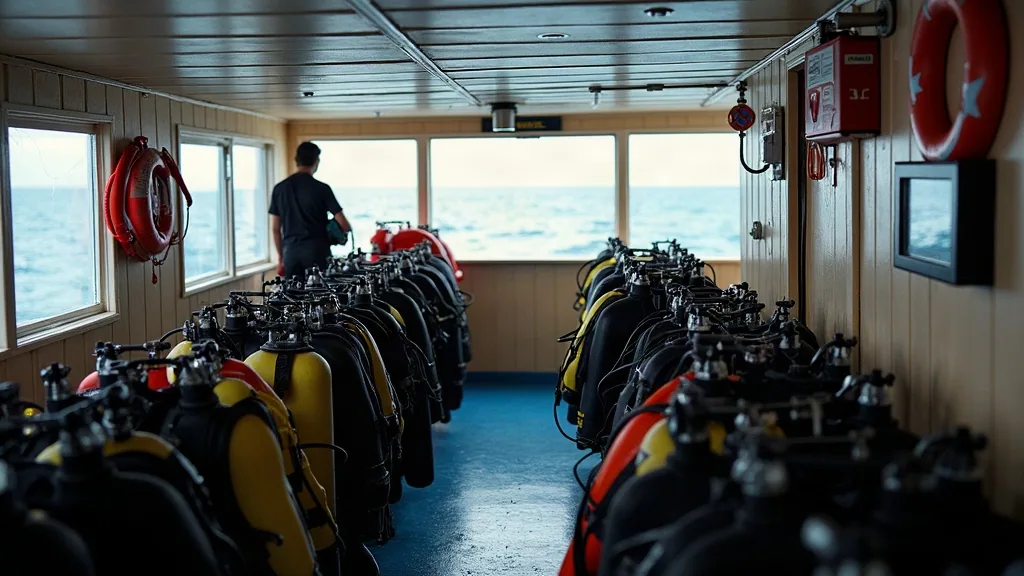
A dive boat in Raja Ampat carries two safety obligations at once: it is a passenger vessel and it
is a diving platform. The vessel side is inspected; the diving side frequently is not, which is exactly why it is
where the gaps accumulate. This checklist covers both, in the order an operator should work through them before a season.
1. Vessel lifesaving appliances
- Liferafts — quantity for maximum persons aboard, current service date, hydrostatic release in date, stowage that will
actually float free - Lifejackets — full complement plus children’s sizes if carried, condition checked rather than assumed, lights and whistles
present, stowage accessible from cabins and the dive deck - Lifebuoys with lights and lines, positioned where someone can reach them at night
- Pyrotechnics and distress signals in date
- EPIRB registered to the vessel with current registration details and battery in date
- Immersion or thermal protection appropriate to the operation
Expiry dates are the single most common finding. Service intervals are administrative, not optional, and a lapsed raft
service will hold up movement documentation as effectively as a structural defect.
2. Fire safety
- Portable extinguishers by type and location, serviced and in date
- Fixed system in the engine space — condition, actuation route, and crew who know where the release is
- Fire detection and alarms tested, not just installed
- Fire pump, hoses and nozzles operable, with a hydrant reachable from both ends of the vessel
- Emergency stops for fuel and ventilation, clearly labelled
- Galley and compressor room specifically — the two highest-risk compartments after the engine room
3. Bilge, flooding and machinery alarms
- Bilge pumping capacity, independence of the pumps, and an emergency route that does not depend on main power
- Bilge alarms in every compartment, tested at the float rather than at the panel
- Engine and generator alarms, high water temperature and low oil pressure, audible in the wheelhouse
- Watertight and weathertight closures functional, dogs and seals in condition
4. Navigation, communication and redundancy
- VHF with a working DSC installation and a correctly programmed MMSI
- Long-range communications — HF or satellite — because much of Raja Ampat is outside mobile coverage
- Backup handheld VHF, charged, with a means of charging independent of the main system
- Navigation lights and shapes, including anchor lights that actually work at night
- Radar, AIS, echo sounder and plotter functional, with paper or offline backup charting
Electrical and electronics condition is covered on the
marine electrical page. Charging benches for torches and
camera batteries deserve specific attention — improvised lithium charging on an unfused circuit is a genuine fire risk found on
more vessels than it should be.
5. Dive-specific equipment
- Breathing-air compressor serviced to running hours, filtration changed on a schedule calculated for tropical humidity
- Gas quality tested and the result recorded and dated — the only objective evidence you have
- Air intake positioned clear of generator and tender exhaust, checked against prevailing airflow at anchor
- Nitrox analysers calibrated, blending records maintained, oxygen-clean practice observed downstream of enrichment
- Cylinders within test date, valves serviced, racks secured against a beam sea
- HP hoses and whips within life, properly restrained
- Emergency oxygen — sufficient quantity for the distance from definitive care, delivery equipment complete and functional,
stowed on the dive deck rather than in a locker below - First aid kit appropriate to a remote operation, and crew trained to use it
- Surface marker buoys, DSMBs, whistles and signalling devices carried by every diver
- Tender and RIB with fuel, radio and a competent operator available during every dive
Compressor and nitrox detail is on the
dive liveaboard systems page.
6. Procedures and drills
Equipment without practice is inventory. Before a season: abandon-ship and fire drills with the actual crew who will sail;
a diver-missing procedure rehearsed, including who takes the tender and who keeps eyes on the water; a medical evacuation plan
naming the nearest facilities and the realistic timeline from each operating area; and a briefing routine for guests that is
delivered rather than assumed.
The evacuation timeline deserves honest arithmetic. From the northern or southern extremities of the archipelago, the
distance to definitive medical care is measured in many hours. That single fact should shape oxygen provision, communications
redundancy and the threshold at which a trip is curtailed.
7. Records
Keep a single safety file with every service date, test result and drill record in it, reviewed monthly rather than
annually. It is what a surveyor asks for, what an insurer asks for after an incident, and what a serious charter client’s risk
assessment will ask for before booking. Survey preparation is covered under
survey coordination.
We prepare and verify equipment and arrangements, and we document what we do. We do not issue certificates and we do not
claim approvals we do not hold.
Talk to the repair desk
Send the vessel particulars — length overall, beam, draft, hull material, displacement, current location and the window you have available — and the Raja Ampat Shipyard Desk will come back with a written scope and a quotation in USD for a pre-season safety and dive-systems review. Quotations name the yard, the slipway or dock, the work sequence and the assumptions behind every line.
WhatsApp: +6281139414563
Email: bd@juaraholding.com
Contracts for construction, repair, refit and vessel-sale work are issued by PT Komodo Galangan Nusantara. All quotations are stated in USD.
Frequently asked questions
What is the most commonly missed item on dive boats here?
Expiry and service dates — liferafts, extinguishers, cylinder tests and pyrotechnics. After that, air intake position relative to generator and tender exhaust, which is a carbon monoxide risk that hides until the wind sits wrong.
How much emergency oxygen should a Raja Ampat liveaboard carry?
Enough for the realistic evacuation timeline from your operating areas, which in the far north and south of the archipelago is many hours. Work backwards from that timeline rather than from a minimum quantity.
Does gas quality need to be tested if the compressor is serviced?
Yes. Service confirms the machine was maintained; a gas test confirms what came out of it on that date. It is the only objective record an operator has, and it is what an insurer will ask for after an incident.
Do you certify dive vessels as compliant?
No. We prepare, verify and document, and we coordinate attendance by the appropriate surveyor or authority. Certificates are issued by the relevant body, not by us.