Marine Generator Troubleshooting at Anchor: A Practical Order
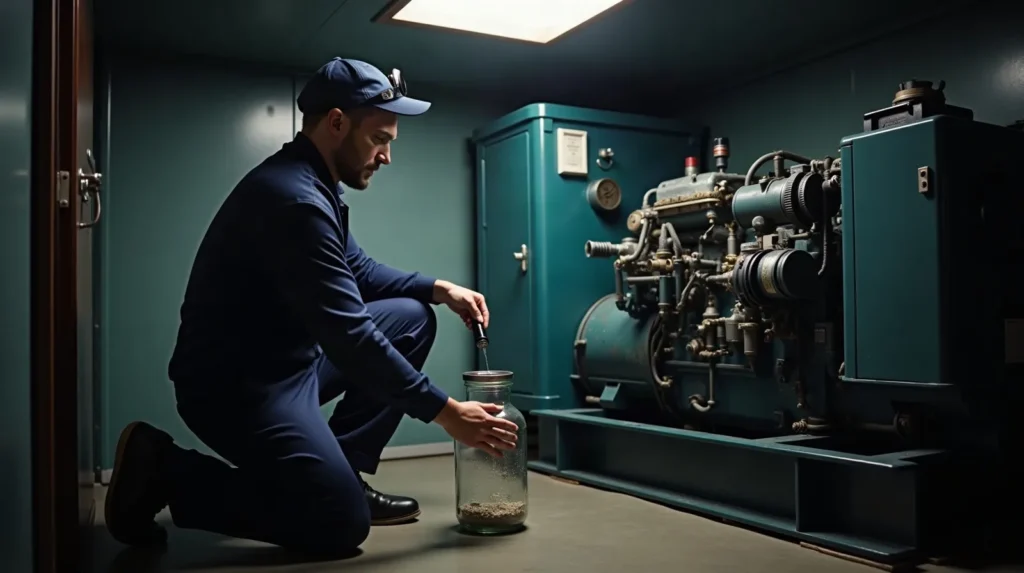
When a marine generator will not start or will not hold load at anchor, work the problem in this order: fuel, air, cooling, electrical controls, and only then the machine’s internals — because on generators the humble causes outnumber the expensive ones by ten to one. This is the practical sequence for a liveaboard crew a day’s sail from the nearest technician, written to be followed with the tools already aboard.
Before anything else: read what the machine is telling you
Modern gensets shut themselves down for reasons they mostly announce — low oil pressure, high coolant temperature, overspeed, sensor faults. Find the fault code or lamp pattern and write it down before resetting anything; a code cleared unread is diagnostic evidence destroyed. Note also the circumstances: did it stop under heavy load, fail to fire on a morning start, or die slowly with a labouring note? Sudden stop under load and slow strangulation have different suspects.
Fuel first — always fuel first
Perhaps seven out of ten generator failures in this operating area are fuel-side. The generator usually drinks from the same tanks as the mains but through smaller pipes, filters and pumps, so it is the first machine to complain about water, sludge or bacterial growth in the fuel. The sequence:
- Drain the primary filter/separator bowl into a clear jar. Water, black sludge or dark stringy material is your answer — and a warning the tanks need attention, covered fully in the fuel system troubleshooting guide.
- Change the primary and secondary elements if there is any doubt. Filters are consumables; treat them that way.
- Bleed the system per the engine’s procedure. Many small gensets self-bleed; the stubborn ones want the manual open.
- Check the tank pickup and any changeover valves — a valve half-closed by a knee in the engine room has stranded better crews than yours.
Air and cooling: the tropical pair
A generator in a sealed, sound-shielded box in a 45°C engine room is working harder than its datasheet imagined. Two checks: first, air — a blocked engine-room vent, a collapsed intake hose or a sound-shield panel refitted wrong starves the machine; black smoke and falling revs under load are the sign. Second, cooling — raw-water flow is life. Check the strainer, feel the discharge, and if flow is weak, suspect the impeller: in warm water impellers age fast, and a shed vane travels downstream into the heat exchanger where it keeps causing overheats until found. Carry impellers in numbers, change them by calendar not by failure, and when one sheds vanes, hunt every fragment. Overheat shutdowns that appear only at high load with a clean strainer usually mean a fouled heat exchanger core — a descaling job that a field visit handles routinely.
Electrical: the side crews fear and shouldn’t
Start failures divide neatly: silence (dead battery, isolator off, corroded terminal, failed solenoid — check in that order with a voltmeter), cranking without firing (back to fuel and stop solenoids), and firing then dying (sensor interlocks, oil pressure switch, fuel lift). On the output side, a set that runs but makes no power usually has a tripped breaker, a failed AVR, or lost excitation; a set whose voltage or frequency wanders under load points at the governor or a load problem — one large motor starting, not a generator dying. Photograph the control panel and wiring before touching connections; the photo you send matters more than the description.
Load discipline: the failure you can schedule away
Generators are also killed slowly, by how they are run. Long hours at a fraction of rated load glaze cylinder bores and soot exhausts — the classic overnight pattern of one set idling against a few fans. Sustained running at the ragged top of capacity, usually when air-conditioning, watermaker and dive compressor all land together, cooks windings and shortens everything. The fix costs nothing: plan the big loads into deliberate blocks so the set runs in its happy middle band, and where twin sets are fitted, alternate them by the hour meter rather than by habit, so both machines age evenly and both get exercised under real load.
What a field visit can and cannot fix
At anchor in the Raja Ampat area, a mobile engineer can realistically complete: full fuel-system service, impeller and cooling work including exchanger descaling, AVR and control diagnostics with replacement where the part is carried, valve adjustments, and top-end inspection. What travels to Sorong: crankshaft and bearing work, stator rewinds, and any overhaul that wants the set unbolted and benched — the honest split described on the generator and electrical repair desk page. Vibration that arrived at the same time as the electrical trouble deserves its own look — see the drivetrain vibration diagnosis guide — because failing mounts shake connections loose and generators get blamed for what the hull is doing.
Send the desk the fault code, the circumstances of failure, the jar photo from the filter drain and the panel photo, and remote triage will usually land within one component family before anyone travels.
WhatsApp: +6281139414563
Email: bd@juaraholding.com
Repair and coordination contracts are issued by PT Komodo Galangan Nusantara. All quotations are stated in USD.
Frequently asked questions
Why does my generator keep shutting down on overheat?
Check raw-water flow first: strainer, impeller condition, then heat-exchanger fouling — including vane fragments from a previously failed impeller lodged in the core. High-load-only overheats with good flow usually mean the exchanger needs descaling.
The generator cranks but will not fire. What first?
Fuel: drain the separator bowl, change doubtful filters, bleed the system, and confirm the stop solenoid is actually releasing. The overwhelming majority of no-fire cases at anchor are fuel-side.
Can an AVR be replaced at anchor?
Yes, when the correct spare is aboard or carried by the visiting engineer — it is a board swap plus setup. Sets that run normally but produce no output are classic AVR or excitation cases.
What generator spares should a liveaboard carry here?
Impellers in quantity, full filter sets, belts, a spare AVR, stop solenoid and temperature/pressure senders. Everything else can follow through the spares channel; these items end trips when missing.