Hull Thickness Gauging: When Steel Boats Need Ultrasonic Checks
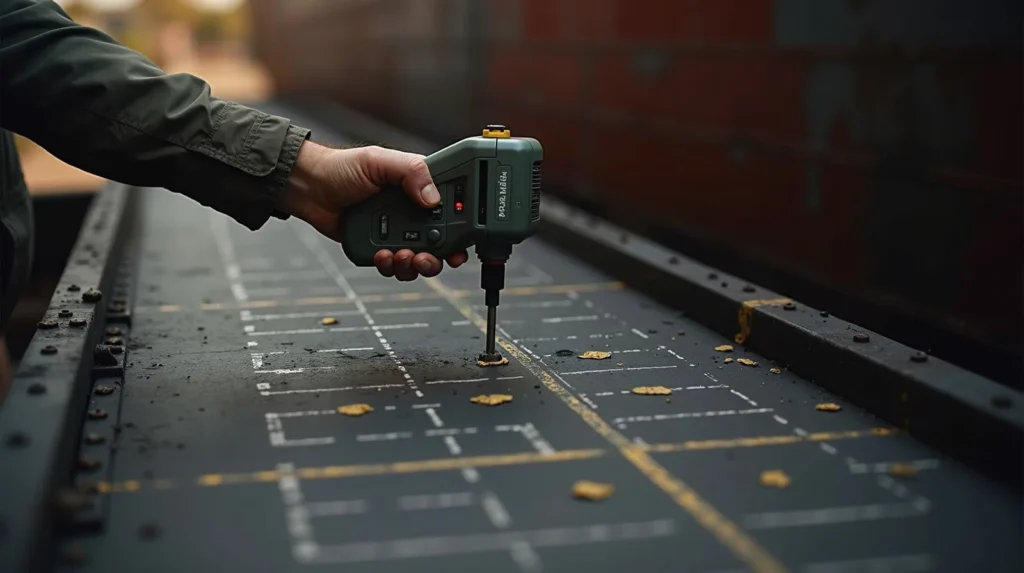
A steel boat needs ultrasonic thickness gauging whenever a decision hangs on the state of her plate: before buying, before class or insurance renewal, after grounding or visible wastage, and on a routine cycle — typically alongside each major docking — once she passes her first decade. This guide explains when gauging is due, how a proper survey is run, and how to read the numbers it produces, because a sheet of readings is only as useful as the judgement applied to it.
Why steel lies to the eye
Steel hulls fail from the inside and from the hidden faces: the bilge turn under sodden insulation, tank tops under permanent ballast water, the plate behind a rubbing strake, the counter where exhaust condensate collects. Outside, a hull can present honest paint over lace; inside, linings and tanks hide the evidence. Ultrasonic testing — a probe measuring plate thickness through one face by echo timing — is the only practical way to see the true section without destructive openings, and its entire value lies in where the readings are taken and how they are compared.
The trigger events, in practice
- Purchase — no used steel vessel should change hands on visual inspection alone; a gauging map is the buyer’s single best negotiating document.
- Class and insurance cycles — classification societies require gauging at defined survey intervals, and insurers of older steel vessels increasingly ask for recent readings before renewal.
- After grounding or collision — deformation stretches and works plate; readings around the damage establish what is repair and what is renewal.
- Visible symptoms — weeping seams, scale blooms under paint, doublers of unknown history, or any rust streak that returns quickly after treatment.
- Routine on age — from roughly ten years on, a gauging pass at each major docking turns corrosion from a surprise into a trend line.
How a credible gauging survey is run
A useful survey is systematic, not anecdotal. The hull is divided into a grid — plates identified frame by frame, readings taken at defined points plus extra attention at the known trouble zones (bilge turns, waterline, weld margins, tank boundaries, under fittings). Surface preparation matters: scale and thick paint scatter the echo, so spots are ground or the surveyor uses multi-echo equipment rated for coated plate. Each reading is recorded against its location, producing a map that can be compared with the original scantlings and with the last survey’s map. Beware the gauging report that is a list of numbers without locations — it cannot be trended, and trending is the point. In this region, gauging coordinates naturally with docking windows, since the same slipway period serves the docking preparation sequence and gives access to cleaned, ground plate.
Reading the numbers: wastage, not thickness
A single reading means little; the comparison means everything. The working logic runs on percentage wastage from the original plate thickness. Broadly — and class rules define this precisely for surveyed vessels — plate that has lost only a few percent is monitored; wastage approaching the society’s substantial-corrosion thresholds calls for closer-spaced readings and a plan; and plate beyond allowable limits is renewed, not treated. Pattern matters as much as depth: uniform thinning across a plate reads differently from sharp local pitting, which concentrates risk and can perforate while the average still looks respectable. The output of a good survey is therefore not a verdict but a marked-up drawing: monitor here, re-inspect there, crop and renew this. That drawing is exactly what a repair specification is built from — the bridge between survey and plating and insert renewal work.
What gauging costs — and what it saves
Against the scale of any docking, gauging is a minor line: equipment, an operator’s days, and some grinding. What it buys is decision quality on the most expensive subject a steel boat has. A hull gauged on schedule renews a handful of plates per decade at planned prices, in planned dockings, with steel ordered ahead. A hull never gauged renews the same plates eventually — discovered by a surveyor at survey time or by seawater at sea time, at emergency prices, in an unplanned docking, with the vessel out of service while steel is freighted east. The survey does not change what the hull needs; it changes who chooses the timing, the owner or the corrosion.
Arranging gauging in eastern Indonesia
For vessels working Raja Ampat, gauging is coordinated through the survey coordination desk for the Sorong region — equipment and operator matched to the job, class surveyor attendance arranged where the readings feed a BKI or insurance survey, and the results delivered as a located map, not a bare list. Where readings drive repair, the desk turns the marked-up drawing into a work specification and a docking plan in the same conversation. The wider West Papua context — what steel condition typically looks like in this fleet and climate — is covered in the regional hull-condition overview, and the insurance dimension in the marine insurance damage survey guide.
WhatsApp: +6281139414563
Email: bd@juaraholding.com
Survey coordination contracts are issued by PT Komodo Galangan Nusantara. All quotations are stated in USD.
Frequently asked questions
At what age does a steel boat need routine thickness gauging?
From roughly ten years, a gauging pass at each major docking is prudent practice, tightening with age. Class-surveyed vessels follow their society’s defined intervals regardless of appearance.
Can thickness be measured through paint?
With multi-echo equipment on sound coatings, yes; on scale, thick or failing paint, spots must be ground clean. A surveyor who never grinds a spot is measuring the coating’s optimism.
How much plate wastage is acceptable?
It is judged as percentage loss from original thickness against class or design criteria — monitored at low percentages, planned for renewal as it approaches allowable limits. Localised pitting is judged more strictly than uniform thinning.
Does gauging require haul-out?
Internal and topside readings can be taken afloat where access allows, but a full bottom map needs the hull out of the water and cleaned — which is why gauging is normally bundled into a planned docking window.
Related reading: Planning Intermediate and Special Surveys in Eastern Indonesia.