Hull Thickness Measurement and Steel Condition in West Papua Waters
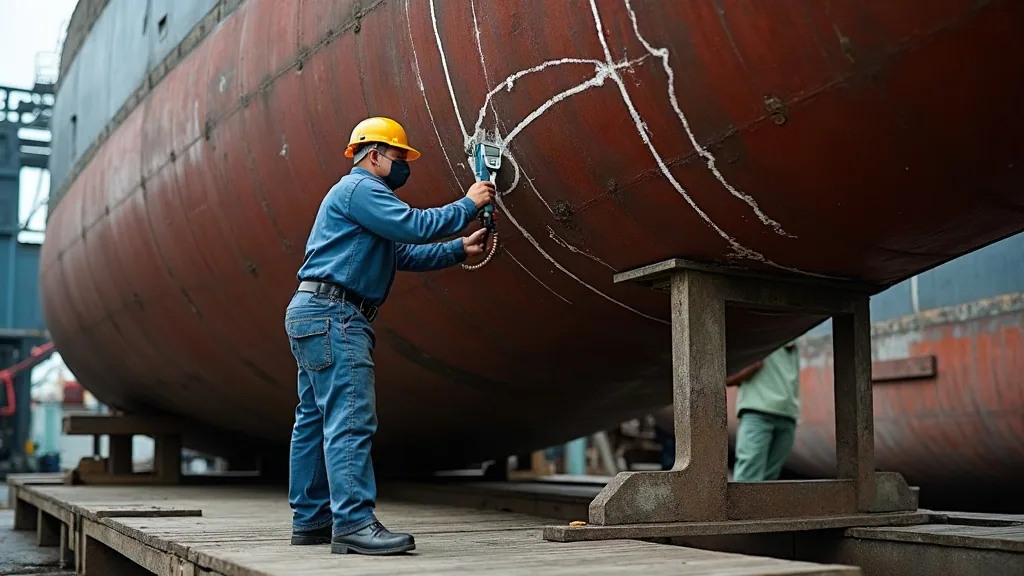
A thickness measurement campaign is not a formality you complete during a docking — it is the
document that decides how much steel you renew, how much you argue with a surveyor, and what your vessel is worth. In
West Papua waters it is also the only reliable way to separate a hull that looks tired from one that actually is.
Why steel wastes faster here
Vessels working Raja Ampat sit in warm, well-oxygenated, high-salinity water and spend a large part of their life at anchor
rather than moving. Warm water accelerates the electrochemistry, high dissolved oxygen sustains it, and low water movement lets
biofilm and localised cells establish under a failing coating. The result is not uniform wastage across the shell — it is
concentrated, and it is concentrated in predictable places.
- Boot-top and splash zone, where wetting and drying cycles destroy coatings fastest
- Under failed antifouling, particularly where a scheme was overcoated onto an incompatible base
- Ballast and fresh-water tank internals, where coatings are old and inspection is rare
- Bilge wells and under engine beds, where oily water and debris sit permanently
- Behind insulation and linings, where condensation runs and nobody has looked in ten years
- Around sea chests, discharges and shaft brackets, where dissimilar metals meet
A campaign that takes readings only on the accessible outer shell will produce reassuring numbers and miss the wastage that
actually matters.
Planning a campaign
Do this before the vessel is on the cradle, not during.
- Get the original scantlings. Build drawings or the class plan approval package. Without an as-built
thickness there is no reference and a reading is just a number. - Agree the grid with the surveyor. Which strakes, which frames, which tanks, how many readings per plate,
and what triggers expansion into a wider survey of that area. Agreeing this in advance is what keeps the campaign to one
attendance. - Prepare the surfaces. Ultrasonic readings need a clean substrate — paint, scale and marine growth must be
removed at each point. Preparation is the cost driver, not the gauge. - Prepare internal access. Tanks gas-freed and certified safe for entry, insulation removed in reading
areas, staging built. This is where campaigns collapse; see
survey coordination. - Use the right operator. A qualified thickness measurement operator whose reports the attending society
will accept. Readings taken by whoever had the gauge are not evidence.
Reading the results properly
Two vessels can show the same average diminution and be in completely different condition. What matters is the pattern.
- Uniform mild loss across a strake usually means general coating breakdown — manageable, and often
addressed by a proper coating reset rather than plate renewal. - Localised deep loss — a small area well below the allowable — points to pitting or a galvanic cell, and
often means the surrounding plate is sound. That is an insert, not a strake renewal. - A trend across surveys is more valuable than any single campaign. Two datasets five years apart tell you
the wastage rate, which tells you whether renewal can wait one more cycle.
This is why the readings, plotted and marked up on plans, belong in the vessel’s permanent job file. A campaign that exists
only as a PDF nobody can find at the next survey has to be repeated, at full cost.
Doublers, and the conversation nobody enjoys
The eastern Indonesian fleet contains a lot of steel plated over with doublers welded on top of wasted material. It is
faster and less expensive on the day. The problem arrives at special survey: doublers are increasingly rejected, because
nobody can measure what is underneath and the crevice between the two plates corrodes unseen. If your readings come back
suspiciously healthy in an area you know has a doubler, the healthy reading is the doubler. Removal and insert plating is
covered on the steel and fibreglass hull repair page.
Where the campaign fits in a docking
Immediately after the high-pressure wash and any preparatory blasting in the reading areas, and before any coating goes on.
Take readings first, decide renewal second, cut and weld third, blast and coat fourth. Reversing any two of those steps means
paying twice — freshly applied paint removed to take readings is the most common example, and it happens on West Papua dockings
every season. Sequencing is covered under
refit project management.
What it costs, and what it saves
The cost is mostly access and preparation: staging, gas-freeing, insulation removal, surface cleaning at each point, and the
operator’s time and travel. Against that, a good campaign does three things. It stops you renewing plate that did not need
renewing. It stops a surveyor imposing a wider opening-up because the data was too thin to support a judgement. And it gives you
a defensible position at sale or refinancing, where “we think she’s fine” is worth nothing and a plotted dataset is worth real
money. Budget structure is on the
costs and budgeting page.
For wooden hulls
Thickness measurement does not transfer. The equivalent evidence base for a phinisi is fastening withdrawal sampling,
moisture readings, frame and floor inspection and caulking condition — different technique, same principle: sample
systematically, record it, and make renewal decisions from data rather than from how the paint looks. See
wooden boat and phinisi repair.
Talk to the repair desk
Send the vessel particulars — length overall, beam, draft, hull material, displacement, current location and the window you have available — and the Raja Ampat Shipyard Desk will come back with a written scope and a quotation in USD for a thickness measurement campaign and the renewal decisions that follow. Quotations name the yard, the slipway or dock, the work sequence and the assumptions behind every line.
WhatsApp: +6281139414563
Email: bd@juaraholding.com
Contracts for construction, repair, refit and vessel-sale work are issued by PT Komodo Galangan Nusantara. All quotations are stated in USD.
Frequently asked questions
How many readings does a thickness campaign need?
It depends on the vessel’s age, class cycle and previous history, and the grid should be agreed with the attending surveyor before the vessel is lifted. Agreeing it in advance is what keeps the campaign to a single attendance.
Can readings be taken through paint?
No, not reliably. Each reading point must be cleaned back to sound substrate. Surface preparation and access, not the gauge itself, are what the campaign actually costs.
What if the readings come back better than expected in a doubled area?
You are almost certainly measuring the doubler, not the original plate. Doubled areas need to be assessed on the basis that the material underneath is unknown, which is one reason doublers are increasingly rejected at special survey.
When in the docking should readings be taken?
After the wash and any preparatory blasting in the reading areas, and before any coating is applied. Readings first, renewal decision second, welding third, coating last — reversing that order means paying for the same preparation twice.