Dive Compressor Air Purity: Testing Standards & Service Intervals
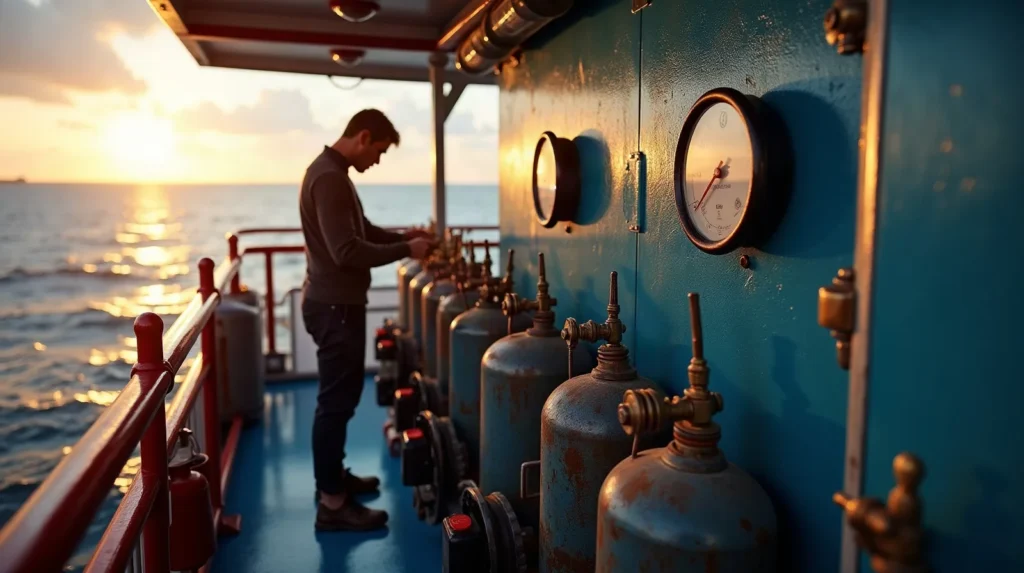
Breathing-air purity on a dive boat is governed by recognised standards — EN 12021 in most of the diving world, with CGA Grade E the common North American reference — and meeting them is not a certificate on a wall but a discipline: filter stacks changed by hours run, quarterly air-quality tests, and a compressor intake that never breathes its own exhaust. This guide covers what the standards actually require, how often to test, and the service intervals that keep a liveaboard’s air beyond reproach.
What the standards actually limit
Air-purity standards set maximum levels for the contaminants a compressor can put into a cylinder: carbon monoxide and carbon dioxide, oil mist, water vapour, and odour or taste. Each has a different source and a different defence. CO enters through the intake — exhaust from the compressor’s own drive or the vessel’s generator — and is the contaminant that kills. CO2 concentrates when intake air is poor or ventilation fails. Oil mist means worn rings or exhausted coalescing filtration. Water vapour reflects filter-stack condition and matters doubly for nitrox systems, where moisture degrades membranes and accelerates oxygen-system corrosion. The numbers vary slightly between standards; the operational meaning does not — clean intake, healthy compressor, live filtration, verified by test.
Testing: how often and what kind
The industry-accepted rhythm for a working dive operation is quarterly laboratory air tests, with an immediate additional test after any compressor overhaul, filter-system change, intake modification, or event that could have contaminated the system. Between laboratory tests, two onboard habits close the gap: CO detection — inline electronic monitors or single-use indicators on the filling whip — and the crew’s own senses, because air that smells or tastes of anything is failed air regardless of what the last certificate said. Keep every test report aboard and dated; charter guests, dive-safety auditors and insurers all ask for the same folder, and a complete one answers questions before they become problems.
Filter stacks: hours, not months
The filter tower is a consumable that masquerades as a component. Its cartridges — molecular sieve for water, activated carbon for oil and odour, hopcalite for CO conversion where fitted — exhaust by hours run and by humidity, and in tropical air the humidity term dominates. The honest practice: log every running hour, derate the manufacturer’s cartridge life for tropical humidity, and change on the logged schedule rather than on smell — because by the time filtration failure is detectable at the whip, cylinders already contain the evidence. The same logbook should carry compressor oil changes (with the correct oil class for breathing-air machines — never a substitute), interstage drain behaviour, and final-pressure performance, since a compressor that takes visibly longer to fill the same bank is telling you about ring or valve wear months before failure.
The intake: the least expensive safety device aboard
More air-quality incidents trace to intake placement than to any mechanical fault. The intake must draw from clean, moving outside air — routed high, clear of every exhaust on the vessel, and re-checked whenever anything changes: a generator run during filling that was never run before, a wind direction that folds exhaust back along the deck, an awning that creates a still pocket. The rule that costs nothing: nobody starts an engine or generator during cylinder filling without the compressor operator’s knowledge, and the operator’s authority to stop filling is absolute.
The paper trail guests never see and auditors always ask for
A liveaboard’s air-quality system ultimately lives or dies as a set of documents: the compressor hour log, the filter-change record, the quarterly test certificates, the analyser calibration log, and the intake-check notes after any deck change. Keeping them as one folder — physical or digital — costs the crew minutes a week and transforms three conversations: the dive-safety audit that ends in an hour instead of a day, the insurance question after any incident anywhere near gas quality, and the charter broker’s due-diligence list before a season contract. The operations that maintain this folder are, not coincidentally, the same ones whose compressors rarely surprise them; the record-keeping habit and the maintenance habit are the same muscle.
Nitrox systems: the extra discipline
Membrane nitrox systems add two requirements to everything above: drier air, because moisture is the membrane’s enemy, and oxygen-clean handling downstream, because enriched air raises the fire stakes in valves, whips and analysers. Membrane performance drifts with temperature and feed pressure, so the analyser — calibrated on a logged schedule — is the only truth about what percentage is actually going into a cylinder. Service for the whole chain, from compressor overhaul through filter logistics to nitrox membrane care and air-test coordination, is what the dive-systems service desk for Raja Ampat exists to provide, with consumables planned by season through a preventive maintenance arrangement rather than by emergency freight. Generator health during filling matters too — the companion piece on generator troubleshooting at anchor is the other half of clean filling sessions.
WhatsApp: +6281139414563
Email: bd@juaraholding.com
Service and coordination contracts are issued by PT Komodo Galangan Nusantara. All quotations are stated in USD.
Frequently asked questions
How often should a dive boat test its breathing air?
Quarterly laboratory tests are the accepted working rhythm, plus an immediate test after any overhaul, filter change, intake modification or suspected contamination event. Onboard CO monitoring covers the gaps between tests.
What standard applies to dive compressor air quality?
EN 12021 is the reference across most of the diving world, with CGA Grade E common in North American practice. Both limit CO, CO2, oil mist, water and odour; the operational disciplines that meet them are identical.
How often should compressor filter cartridges be changed?
By logged running hours, derated for tropical humidity — not by calendar or smell. Humid air exhausts molecular-sieve cartridges far faster than temperate datasheet figures suggest.
Why does nitrox production need drier air?
Moisture degrades separation membranes and corrodes oxygen-enriched downstream components. Membrane systems therefore demand stricter filtration and moisture control than air-only filling, plus routinely calibrated analysers.