Field Welding on Boats: What Mobile Engineers Can Really Do
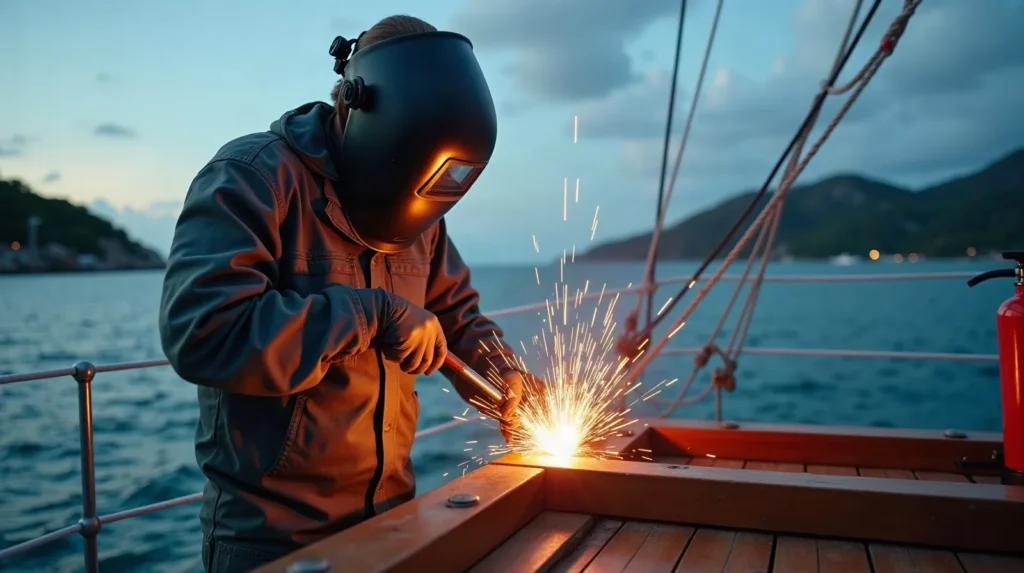
A mobile engineer with a portable welding set can genuinely repair cracked brackets, split tanks above the waterline, broken davits, exhaust hangers and deck fittings at anchor — but hull plating below the waterline, anything structural to class, and most aluminium work belong on the hard. Knowing which side of that line your job sits on saves days of waiting and, occasionally, saves a vessel from a repair that makes things worse.
What a portable set can actually do at anchor
Field welding in the Raja Ampat operating area means a technician, an inverter stick-welding machine or small MIG set, a generator or the vessel’s own power, and whatever access the job allows. Within those limits, real and durable repairs are routine:
- Cracked engine and equipment brackets — the classic call-out. Vibration cracks in steel brackets weld cleanly once the crack is ground out and the load is understood.
- Davits, gantries, ladder and awning frames — structural to nobody but themselves, and very repairable in place.
- Exhaust systems — cracked flanges, split dry sections and broken hangers, welded after proper cooling and fuel-safety isolation.
- Tanks above the waterline — pinholed water and fuel tanks can be patched or seam-welded after gas-freeing; fuel tanks demand rigorous preparation and are refused when they cannot be made safe.
- Topside steel — bulwark cracks, fashion plates and deck fittings, where the work is above water and accessible from deck or a tender.
What field welding cannot honestly do
Three categories get declined, and a desk that says yes to them is a desk to distrust. First, underwater or waterline hull plating: wet welding exists as a specialist commercial discipline, but for the vessels working these waters the honest answer to a holed or thinned bottom is a temporary patch — cement box, plate and sealant, or clamped pad — followed by proper plating work on the hard in Sorong. Second, class-relevant structure: welds on framing, keel structure or plating of a surveyed vessel need approved procedures, prepared surfaces and a surveyor’s eye, none of which exist on a rolling deck. Third, most aluminium: it wants AC TIG, clean preparation and shelter from wind — occasionally achievable on deck under a tarpaulin, but promised only after the technician has seen photographs of the job.
Preparation decides the outcome
The difference between a field weld that lasts five years and one that cracks in five days is rarely the welder — it is the preparation the job allows. Salt-soaked steel must be ground back to bright metal beyond the visible damage; cracks need their ends drilled to stop propagation; paint, insulation and fuel vapour must be cleared from both sides of the work. On a boat this means lifting linings, emptying lockers and sometimes cutting inspection openings, which is why an honest engineer quotes hours for access before quoting minutes for welding. Fire watch matters afloat more than ashore: a slag ball dropped into a bilge full of oily water, or against foam insulation behind a panel, has ended more than one voyage. Expect the technician to demand extinguishers staged, a crew member watching the blind side, and hot-work checks an hour after the last arc.
Power, gas and consumables east of Sorong
Portable inverter machines run happily on a liveaboard’s generator, but shielding gas for MIG and TIG is a Sorong commodity — it does not ride out to Misool in a skiff. That is why stick electrodes, which need no gas and tolerate breeze, remain the workhorse of field repairs here. Low-hydrogen electrodes stored dry aboard the vessel are worth their locker space; the desk advises which sizes suit your steel before a season starts. For jobs that clearly need gas, machine capacity or overhead position work, the calculation usually flips in favour of bringing the vessel to the equipment rather than the equipment to the vessel — the honest arithmetic covered in our guide to choosing between towing and repairing in place.
Temporary versus permanent: label the repair honestly
Every field weld gets a classification before the engineer leaves: permanent, or temporary pending yard attention. A bracket rebuilt with full penetration in clean steel is permanent. A patch over thinned plate, a build-up weld on a corroded fitting, or anything done fighting access and weather gets photographed, logged and booked for proper renewal at the next docking. Vessels that keep this log arrive at their haul-out with a work list instead of a mystery, and surveyors treat a documented temporary repair very differently from an undocumented one found by accident.
How a field welding call-out runs
Photographs first, always: the crack or break up close, the surrounding structure a step back, and the access route. From that the desk confirms whether the job is field-repairable, what preparation the crew can do before the engineer travels (grinding, gas-freeing, emptying compartments), and what it will cost in mobilisation and hours — stated in USD, driven by distance from Sorong staging and sea conditions rather than by the minutes of arc time. The engineer arrives with machine, electrodes and grinding gear, completes the repair, photographs it, and notes anything that should be re-inspected at the next haul-out.
WhatsApp: +6281139414563
Email: bd@juaraholding.com
Field repair and coordination contracts are issued by PT Komodo Galangan Nusantara. All quotations are stated in USD.
Frequently asked questions
Can hull plating be welded below the waterline at anchor?
Not properly. The honest field answer is a temporary patch to control ingress, followed by plating repair on the hard. Wet welding is a specialist commercial discipline that does not apply to typical liveaboard repairs.
Can aluminium be welded on board?
Sometimes — small TIG jobs under shelter with clean preparation. It is promised only after photographs are reviewed, because wind, contamination and access defeat aluminium welds far more easily than steel.
Is it safe to weld on a fuel tank?
Only after the tank is emptied, cleaned and gas-freed to the technician’s satisfaction. A tank that cannot be made verifiably safe is patched mechanically instead, and the welding waits for the yard.
What should the crew prepare before a welding engineer arrives?
Access above all: empty the lockers or lift the linings around the job, grind back paint if instructed, stage extinguishers, and have generator power confirmed. Preparation hours are where call-out money is saved.