Steel & Fibreglass Hull Repair in Sorong and Raja Ampat
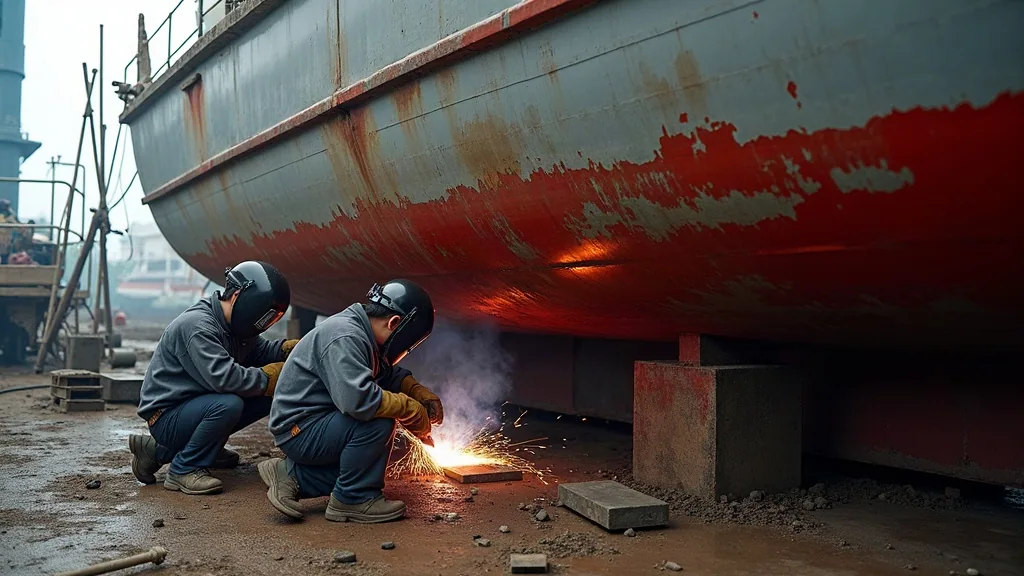
Steel and fibreglass hull repair for vessels working Raja Ampat is carried out on the hard in the
Sorong area, with in-water and afloat repairs available at island anchorages when the damage does not warrant a docking.
We define the repair scope, agree the acceptance standard before the first cut, and supervise the welding, laminating and
coating through to a documented handover.
Steel hulls
The steel liveaboards and workboats operating out of Sorong live in warm, oxygen-rich, high-salinity water and spend a lot of
their life at anchor rather than moving. That combination produces two predictable problems: general wastage in the boot-top and
splash zone, and pitting under failed coatings in tanks, bilges and behind insulation. Both are inexpensive to fix early and expensive
to fix late.
Typical steel scopes we handle:
- Thickness measurement and mapping — ultrasonic readings on a grid, plotted against the original scantlings
so that renewal decisions are made on data rather than on how the plate looks after blasting. Detail is on the
survey coordination page. - Insert plate renewal — cropping out wasted plate and welding in new material of matching grade and thickness,
with edge preparation, back-gouging and fit-up controlled rather than improvised. - Doubler removal — the region is full of vessels carrying doublers welded over thin plate as a low-cost fix.
Surveyors increasingly refuse them. Removing a doubler and inserting proper plate is the difference between passing a special
survey and arguing about it. - Structural members — frames, floors, stringers and bulkhead boundaries where wastage has moved past the
shell into the structure that holds it. - Tanks and voids — internal blasting, pitting weld-up, coating renewal and pressure or hose testing.
- Appendages — rudder stock and blade repair, skeg and bilge-keel renewal, sea-chest and grating work,
anode replacement to a calculated schedule rather than a habit.
Welding processes used are SMAW and GMAW, matched to material and position; welders work to a written procedure and
identified consumables. Where a class society is involved, weld procedures and welder qualification are agreed with the attending
surveyor before production welding starts, not shown to him afterwards.
GRP and composite hulls
Fibreglass dive boats, tenders and speedboats in Raja Ampat suffer a different set of failures — impact damage on reef and
jetty, delamination around through-hulls and hardware, osmotic blistering on older hulls that spend their entire life afloat, and
gelcoat breakdown under continuous UV.
- Damage survey — percussion sounding and moisture readings to establish the real extent of delamination
before quoting, because the visible crack is rarely the boundary of the damage. - Structural laminate repair — grinding back to a controlled scarf ratio, rebuilding with the correct
reinforcement schedule and resin system, and post-cure control in tropical humidity. - Hardware and through-hull rebedding — a large share of GRP water ingress in this fleet comes from
transducer, log and skin-fitting installations that were never properly bedded. - Osmosis treatment — peeling, washing, drying to a measured moisture content, and an epoxy barrier coat.
This is a schedule item, not a two-day job, and the drying time is what drives the docking length. - Gelcoat and topside finish — fairing and finishing tied into the
coatings programme so that surfaces are only prepared once.
Underwater and afloat repair
Not every hull problem justifies pulling a vessel out during a charter season. Where the defect is localised and above the
risk threshold for temporary work, we arrange in-water attention: propeller and rope-cutter clearing, anode replacement,
sea-chest grating work, in-water hull cleaning and inspection, and temporary sealing of small ingress points to get a vessel
safely to Sorong. Underwater welding and permanent structural repair afloat are not offered — a temporary patch that fails at
sea is worse than a cancelled trip. If it needs to come out, we will say so. Response coverage is described on the
emergency and on-site repair page.
Vessel sizes and limits
Hull repair capability is bounded by the lifting facility, not by the workshop. Slipway and dock dimensional limits in the
Sorong area, and how to check whether your vessel fits, are set out on the
haul-out and dry docking page. Send LOA, beam, draft and displacement
and we will confirm before anything is booked. Vessels beyond the local limit are routed to a larger yard in eastern or
central Indonesia, and we will say that at enquiry stage rather than after you have moved.
What the job file contains
Every hull repair we supervise closes with a record: pre-repair thickness or moisture readings, marked-up plans showing
what was renewed, photographs of fit-up and completed welds or laminate before coating, consumable and material identification,
coating specification with wet and dry film readings, and the surveyor’s remarks where class attended. That file is what makes
the next survey less expensive, and it is what an insurer or a buyer will ask for two years from now.
Talk to the repair desk
Send the vessel particulars — length overall, beam, draft, hull material, displacement, current location and the window you have available — and the Raja Ampat Shipyard Desk will come back with a written scope and a quotation in USD for hull and structural repair. Quotations name the yard, the slipway or dock, the work sequence and the assumptions behind every line.
WhatsApp: +6281139414563
Email: bd@juaraholding.com
Contracts for construction, repair, refit and vessel-sale work are issued by PT Komodo Galangan Nusantara. All quotations are stated in USD.
Further reading from the field notes
- Field Welding on Boats: What Mobile Engineers Can Really Do
- Osmosis Blisters on GRP Hulls: Spotting Them Before Haul-Out
Frequently asked questions
Can you repair a steel hull afloat in Raja Ampat?
Localised, low-risk work can be handled afloat — anode renewal, above-waterline plating, sea-chest gratings and temporary sealing. Permanent below-waterline plate renewal requires the vessel to be dry, which means a slipway or dock in the Sorong area. We will not sell a temporary underwater patch as a repair.
How do you decide how much plate to renew?
From ultrasonic thickness readings taken on a grid and compared against the original scantlings and the allowable diminution for the vessel’s class or flag. Decisions are made on the readings, and the readings go in the job file so the next surveyor is not starting from zero.
Do you remove doublers?
Yes, and we generally recommend it. Doublers over wasted plate are common in this fleet and are increasingly rejected at special survey. Cropping the affected area and welding in an insert plate costs more once and less over the life of the vessel.
How long does a typical hull repair docking take?
A routine docking with anode renewal, minor plating and antifouling is usually one to two weeks. Significant plate renewal, tank work or osmosis treatment runs three to six weeks because of drying, blasting and coating cure times rather than the welding itself.