Is There Haul Out Access for Catamarans in West Papua?
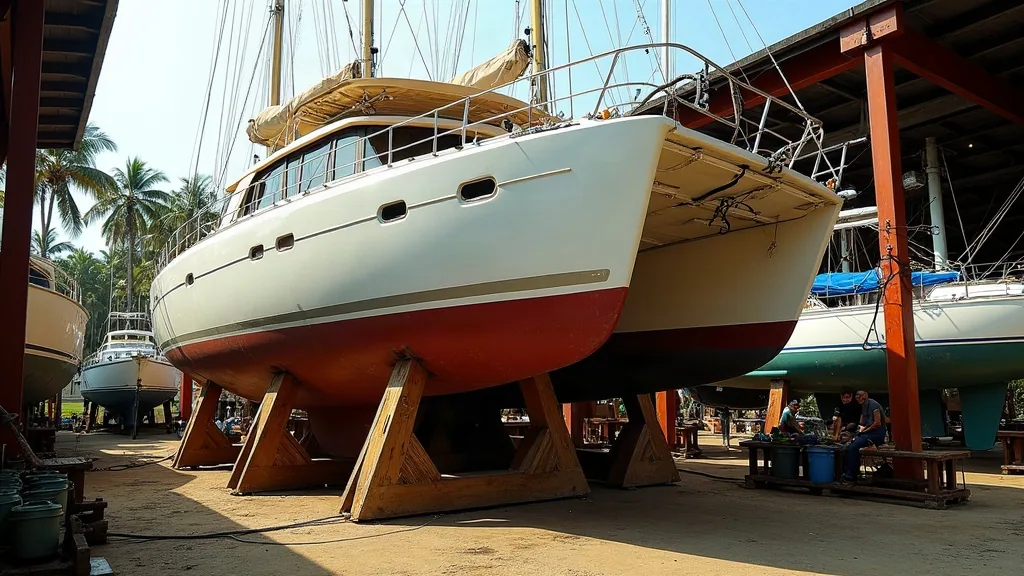
Sometimes — and beam is what decides it, not length. Moderate-beam catamarans can be
hauled in the Sorong area with careful blocking. Wide or heavy multihulls frequently cannot, and the honest answer in those
cases is that another Indonesian yard is the right routing. This is a question to settle before you sail, not on arrival.
Why multihulls are the awkward case
The lifting infrastructure in eastern Indonesia was built for the local fleet: displacement monohulls with a single keel,
moderate beam and a hull form that sits naturally in a cradle. A marine railway centres a vessel over a cradle and shores it
against the topsides. A catamaran presents a fundamentally different problem — two hulls carrying the load, a wide beam that may
exceed the shoring width, and a bridgedeck that must not touch anything.
The binding constraints, in order:
- Beam versus width between shoring. This is the first question and it disqualifies more multihulls than
everything else combined. - Transverse support. The cradle needs beams positioned to carry both hulls at the correct points. Not every
facility has suitable beams available, and improvising them is not acceptable. - Load distribution. Loads concentrate under two hulls rather than spreading along a keel, which matters for
the cradle structure and for the ground beneath it. - Blocking points. The manufacturer specifies where a catamaran may be supported. Blocking outside those
points can damage the structure invisibly, and the owner discovers it later. - Draft over the cradle. Usually the least problematic for a catamaran, which is the one thing in your
favour.
What to send before you plan a transit
- Length overall and waterline length
- Maximum beam — the number that decides everything
- Maximum draft, including any daggerboards or centreboards down and up
- Displacement, light and loaded
- Hull material and construction
- The manufacturer’s lifting and blocking diagram if you have it — this is worth more than any other
document - Rudder and saildrive or shaft configuration, and any protruding gear
We will confirm against current facility limits before you commit. The general process and monohull limits are on the
haul-out and dry docking page.
If the answer is no
There are three honest alternatives, and they should be considered in this order.
1. Do the work afloat
A surprising proportion of a catamaran’s maintenance does not need a lift: engines and saildrive servicing above the
waterline, electrical and electronics, systems, interior, rigging inspection, and in-water hull cleaning and inspection. For a
cruising catamaran in Raja Ampat, this covers most of a normal season. See
engine repair and
marine electrical.
2. Beach or careen — with caution
Catamarans can dry out on a suitable tidal flat, which is a genuine advantage of the type and is how a good deal of
antifouling gets done in remote cruising grounds. It requires a suitable bottom, tidal range, settled weather and a hull the
owner is confident sitting on. It is a legitimate option for antifouling and inspection; it is not an option for structural
work, and it is not something to attempt in an unfamiliar area without local knowledge.
3. Reposition to a yard that fits
For significant structural or below-waterline work on a wide multihull, a passage to a facility with appropriate lifting
capability is the correct answer. It is not the answer anyone wants, but it is considerably better than an improvised lift that
damages a bridgedeck or a hull-to-beam connection.
The improvisation risk
The most expensive outcome here is not being turned away. It is being accepted by somebody willing to improvise. Blocking a
catamaran outside its designed support points can crack bulkhead tabbing, distort a bridgedeck or damage the structural
connection between hulls and beams — and none of that is necessarily visible on the day. If a facility cannot show you how it
intends to support your vessel, and the plan does not match the manufacturer’s diagram, that is a reason to decline. We would
rather tell an owner to route elsewhere than take a job we cannot support properly.
Planning ahead
If you are cruising toward eastern Indonesia in a multihull, ask the question a season in advance rather than when
antifouling is already overdue. Knowing where your nearest suitable lift is — and how many days’ passage away — changes how you
plan a coating interval, which is covered under
antifouling and coatings. Raja Ampat’s fouling rate is aggressive,
and a multihull with limited haul-out options should be specified for the longest practical coating life rather than the
convenient one.
Talk to the repair desk
Send the vessel particulars — length overall, beam, draft, hull material, displacement, current location and the window you have available — and the Raja Ampat Shipyard Desk will come back with a written scope and a quotation in USD for a multihull haul-out assessment. Quotations name the yard, the slipway or dock, the work sequence and the assumptions behind every line.
WhatsApp: +6281139414563
Email: bd@juaraholding.com
Contracts for construction, repair, refit and vessel-sale work are issued by PT Komodo Galangan Nusantara. All quotations are stated in USD.
Frequently asked questions
Can any yard near Sorong lift a catamaran?
Some can handle moderate-beam catamarans with careful blocking. Wide or heavy multihulls frequently cannot be accommodated. The answer depends on beam and on the transverse support available, so confirm before planning a transit.
What is the single most important number?
Maximum beam, measured against the width available between the cradle shoring. It disqualifies more multihulls than length, draft and displacement combined.
Is beaching a catamaran for antifouling a reasonable option?
For antifouling and inspection, on a suitable bottom with adequate tidal range and settled weather, yes — it is a real advantage of the type. It is not suitable for structural work and should not be attempted in an unfamiliar area without local knowledge.
What if a yard offers to lift my catamaran without a proper cradle arrangement?
Decline. Blocking outside the designed support points can damage bulkhead tabbing, the bridgedeck or hull-to-beam connections, and the damage is often not visible on the day. Ask to see the support plan and check it against the manufacturer’s diagram.